In the last few years, the Science of Reading has gotten attention from schools, school board members, curriculum designers, and literacy teachers all across America. Some call it the latest buzzword or fad, while others say that it’s essential for reading instruction. For the last twenty years, it has been the subject of critical studies and research, and it has also been heavily criticized by those in favor of other reading movements such as the Whole Language Approach and Reading Recovery. But what is the Science of Reading, and why is it such a hot topic among teachers?
The Science of Reading is an interdisciplinary study of scientifically based research on how we read. It has elements of cognitive neuroscience, psychology, education, and linguistics (The Reading League). All of these elements have led scientists, psychologists, and teachers to conclude that students need systematic, explicit instruction in order to successfully read. In other words, students need to learn the foundations of word recognition (letters and their sounds, phonics concepts, and sight recognition) and language comprehension (syntax, vocabulary, background schema) in order to be successful readers.

Sounds obvious, no? Unfortunately, the last 20 years of reading instruction in America have NOT included explicit instruction in these concepts. Instead, we have invested in programs that encourage inferencing, memorization, and guessing. Kids who were successful in K-2 (or, rather, appeared to be successful) in reading failed or scored poorly in state tests by 4th grade because they didn’t understand how to effectively decode words or their patterns. Their previous programs worked under the idea that if we taught students to love the act of reading (looking at the pictures, taking time for independent reading, and curling up in a corner with their favorite topic), the rest would come later.

Unfortunately, this means that we have a literacy crisis in America. Only 35% of public school students are literate by Grade 4. According to BeginToRead, 67% of students who don’t have proficient reading skills by the end of 4th grade end up in jail or on welfare, either as teenagers or adults. 23% of adults in America are illiterate. That’s 23% too many.
Teaching students to love books is great. Don’t get me wrong. But explicit instruction needs to come first. We’re seeing the results of programs like Reading Recovery and the Whole Language Movement are proving problematic for all readers, including those with learning disabilities.
But wait… this is a fantasy account! What does SOR have to do with wizards and hobbits?
Great question. It’s my working theory that we teachers can use Invented Languages (for the moment, I’m specifically working with Tolkien’s Sindarin and Quenya) to teach students about patterns in English Morphology.
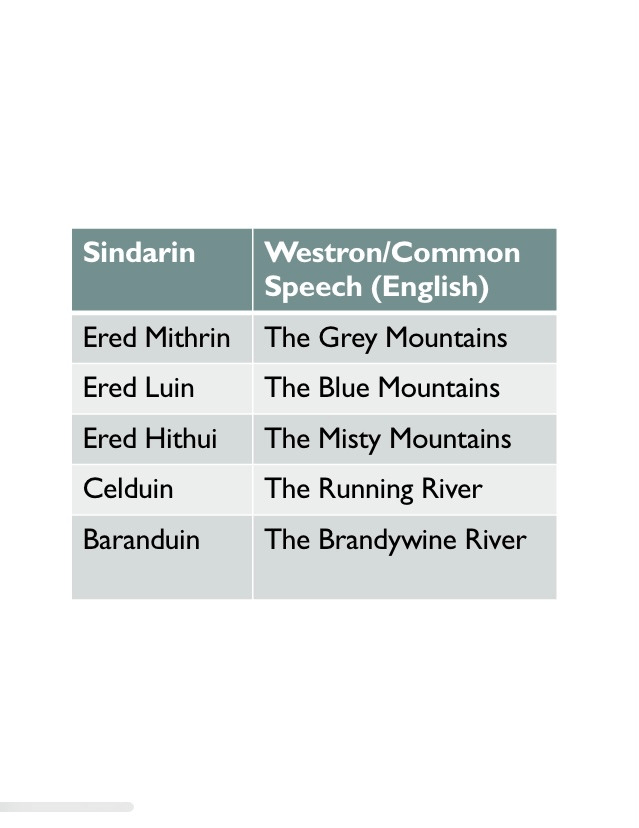
When I teach The Hobbit, I spend some time on Tolkien’s philological work. I show them some words in Sindarin that have the same roots- for example, Branduin and Celeduin, Ered Mithrin and Ered Luin- and their translations. Much like Tolkien would have in his Philological work, we use the clues within these roots and their translations to work backward and determine what these roots might mean. “Uin”, for example, means “river,” and “Ered” means “mountain.”
I also give them a short activity for creating their own invented language with prompts to consider- what roots or root words exist in their language, how does the language indicate plurals, and how does the writing system work in their language?
Greek, Latin, and Old English roots work similarly in the English language. Reading Specialists and SOR experts practice with these roots all the time. It’s part of teaching phonemic awareness and word recognition. Understanding and noticing these patterns within word roots, plurals, prefixes, and suffixes are critical for students to successfully decode words, but they need explicit instruction in order to get there.
This is just the beginning of my research into connecting the Science of Reading to Fantasy Literature, but you can learn more about Linguistics and Word patterns by reading the guest post series by DigitalTolkien here.
For more information on the Science of Reading, you can read:
Shanahan, Timothy: What Constitutes a Science of Reading Instruction
Reading Rockets: What Is the Science of Reading?
The Reading League: The Defining Guide: What is the Science of Reading?
I highly recommend the following podcasts for more information on how the Science of Reading has impacted education:
Sold a Story: How Teaching Kids to Read Went So Wrong
Science of Reading: The Podcast by Amplify
A Novel Idea: The History of the Science of Reading Movement
 Teaching With Magic