Hello readers! I had a wonderful time presenting at DePaul University’s Pop Culture Conference! I had lots of wonderful questions and feedback from the audience, and I am so thankful for Emily Strand and Dr. Amy Sturgis as they supported me and encouraged me to share this topic. I also want to extend a HUGE thank you to my dear friend Mercury Natis for their feedback and editing advice as I scrambled to turn these crazy ideas into coherent sentences.
Now, here is my presentation for you ALL to read and enjoy! As always, feel free to leave a comment, or email questions and any feedback. Thank you!
I was first inspired to write this paper when I saw Ariana Greenblatt’s performance in Part 5 of Ahsoka, “Shadow Warrior.” In this episode, we are brought directly back to The Clone Wars, but this time the medium is drastically different. What was once whimsical, colorful animation is dark, gritty, and very three-dimensional live-action. We are thrust into a hazy, smoky, and deafening battle… Ahsoka has hardly any time to process where she is as Anakin calls for her and the Clone Troops to advance.
It was here, in this flashback, that I realized just how young Ahsoka Tano truly was during the Clone Wars. She was not the adult that Rosario Dawson portrayed her to be… this was a child, a child who was expected to lead ambushes and had to bear the burden of losing soldiers under her command. This was a visceral experience that the animated series had not done for me.

As the battle resumes, the camera zooms in on Ahsoka’s face as she watches Anakin Skywalker disappear in a haze of smoke, only to be replaced by Vader’s silhouette. Her face is frozen in shock as the trauma of the Clone Wars crashes upon her all over again, facing a war that she should never have had to face, let alone be expected to command. In this clip, Ahsoka is hardly older than many of the students I have taught in my career, and it shook me to think that any of them would be able to command forces, let alone participate in a war. But then, I realized that many of my students have done just that, most especially in the last four years as the COVID-19 pandemic emerged and impacted their lives forever.
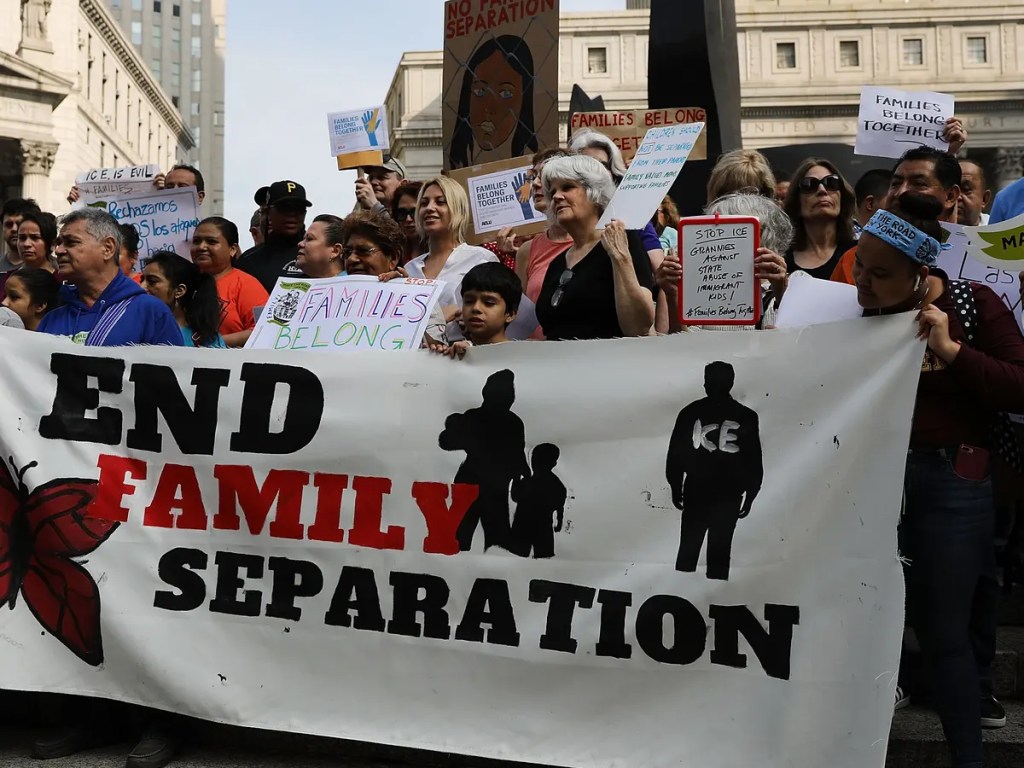
A recent study showed that more than two-thirds of children in the United States have or will experience trauma before the age of sixteen and that this number is likely to increase because 140,000 children have lost a caregiver to COVID-19 in recent years (Ernest, B. W., Reaves, M. & Smith, R., 2022). While concepts of childhood trauma are not inherently new to educators, the COVID-19 pandemic revealed deep-seated systemic issues that showed us exactly how ill-equipped the United States is to deal with trauma, and that our system needs a complete overhaul.
Neuroscience has concluded that trauma, particularly childhood trauma, is dangerous to children and adolescents, and drastically impacts their ability to learn. When children face trauma and conflict, they are in a constant state of stress, and the results directly impact their brains. This is especially dangerous for children and adolescents because their brains are developing, and the elasticity of the brain leaves them especially vulnerable to permanent damage. When a person experiences a stressful or threatening situation, the brain triggers the release of stress hormones that heighten awareness and help prepare the body and brain to respond. We refer to this as our fight-or-flight response.
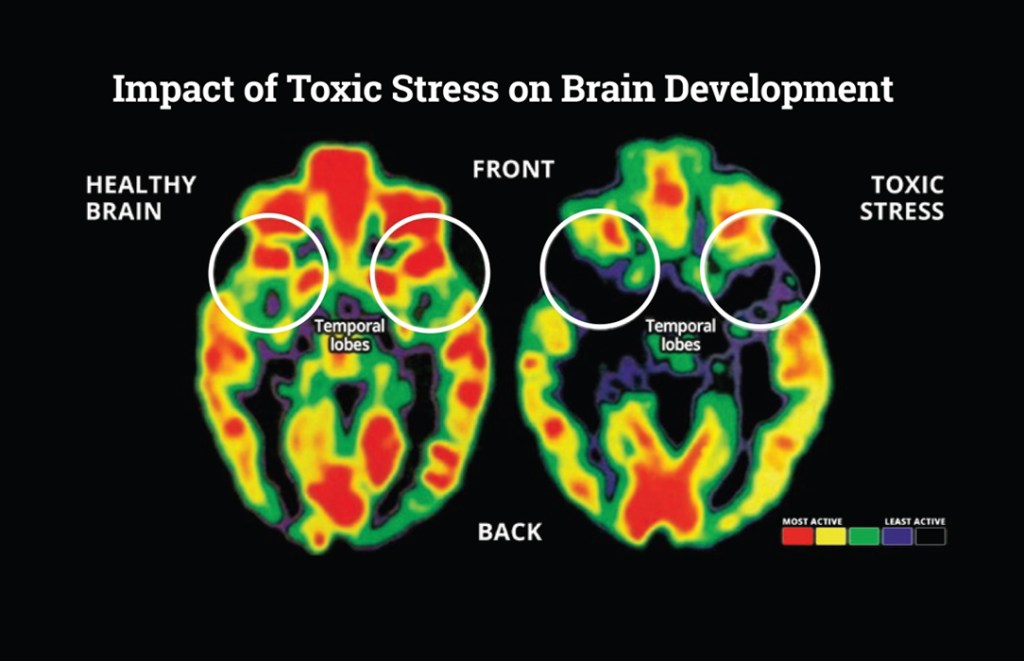
But prolonged activation of the stress response leads to impairments in learning and memory, causing toxic stress, that is stress that is chronic, uncontrollable, and unrelenting. Children with toxic stress are prone to either overreact or under-react to perceived threats, which leads to adverse behaviors. These effects can persist into adulthood if they are not addressed, or if addressed poorly.
Teachers across the country are seeing the consequences of the public school’s inefficient administration, policies, and curricula to help students cope with the trauma of the COVID-19 pandemic. Regardless of whether or not a child has lost a caregiver or a loved one to the illness, they still lost months, if not years, of social interactions, and at best spent most of their time in front of a computer screen and withdrawn from any social interaction or peer collaboration. Teachers are leaving the profession in record numbers because they are simply burnt out from the lack of administrative support, fair wages, and actionable, equitable solutions from the government. Individual teachers care about their students, but when the institution is unsupportive, the individual eventually burns out. Our systems are not currently designed to help students with trauma because of the systemic issues of inequity throughout our society. Likewise, the Jedi also perpetuate and cause trauma, thus leading to its eventual downfall. Ahsoka’s journey through her apprenticeship, and the effects of the institutional trauma, begin at a very young age and continue throughout her education.
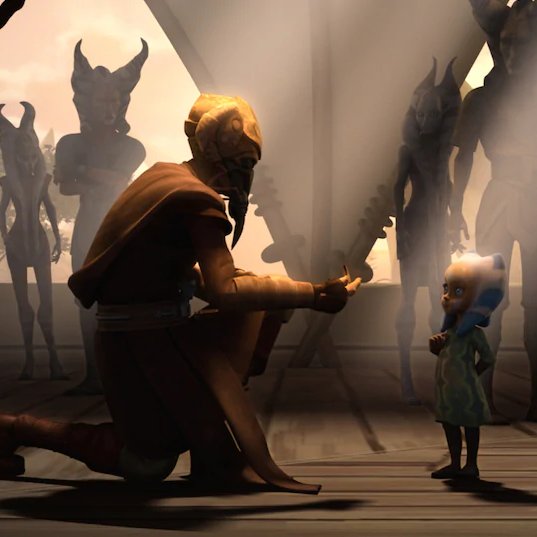
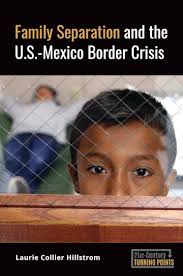

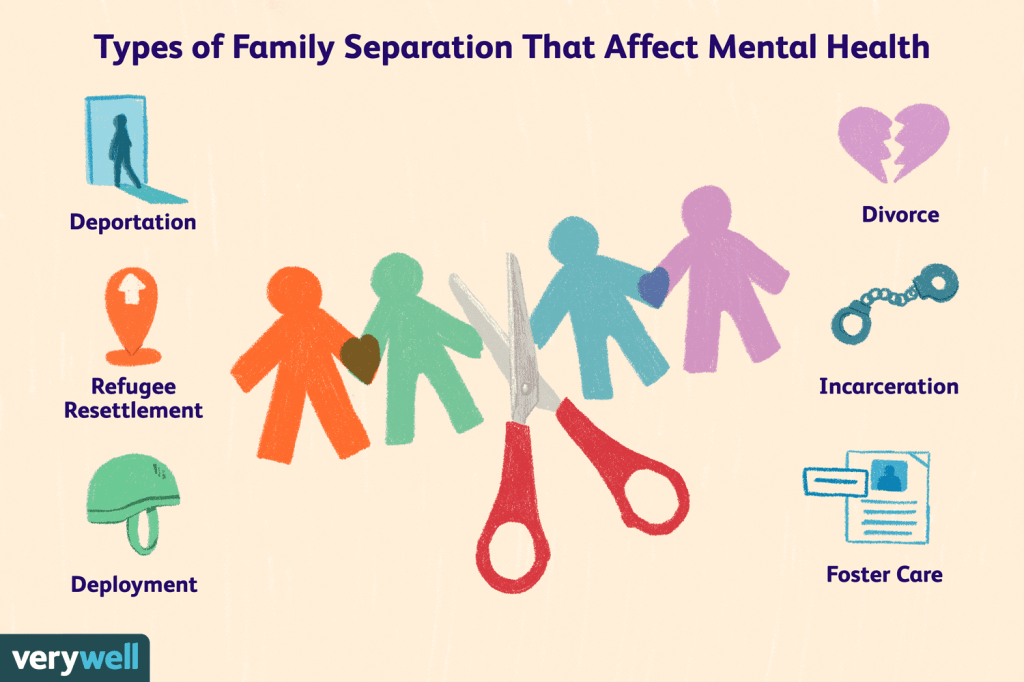
Thankfully, Ahsoka’s training in understanding the Force has given her ample opportunity to learn how to use the Force and the necessary calm needed to access it. Her time in the Jedi Temple, however she got there, has been a beneficial education for her. But the fact remains that she is still a child, and she has exceptional burdens to shoulder as her experiential education takes place throughout the Clone Wars.
Students need to feel safe to make mistakes in the classroom, and if the environment consistently feels unsafe, then children are less likely to learn effectively. Though Ahsoka has the resources and access to meditative techniques and mindfulness practices, the Jedi Council keeps putting her on dangerous, high-stakes missions, and they expect her to be mature enough to hold a command. If a child makes a mistake in, say, a math classroom, the answer can be erased and corrected. But in the Clone Wars, troops died when Ahsoka made mistakes. As a teenager, Ahsoka’s brain was still elastic, and research shows that the adolescent brain continues learning how to adapt to stress and trauma well into the young adult years (Learning Sciences).
| What Does Institutional Trauma Look Like in Our Schools? |
|---|
| Bullying (perpetrated by peers, teachers, or administration), |
| Harassment and homophobia, |
| Punitive, no tolerance, one-size-fits-all policies |
| Gun violence and physical violence, in school and out |
| Abuse, neglect, and poverty in the home, |
| The Deficit Trap: Kids are traumatized, therefore they can’t be “fixed.” Instead, we should be working to fix the systemic injustices that affect our kids. |
In the episode “Storm over Ryloth”, Ahsoka orders her troops to press forward in an attack, and many of her Clone Troops are killed. To be responsible for someone’s death is a heavy burden for anyone, let alone a student. And yet this is a responsibility that the Jedi Masters have thrust upon her. But is this level of extreme an appropriate learning environment? Or is it done simply because the Clone Wars are necessary? And what are the consequences of this on a child’s developing brain?
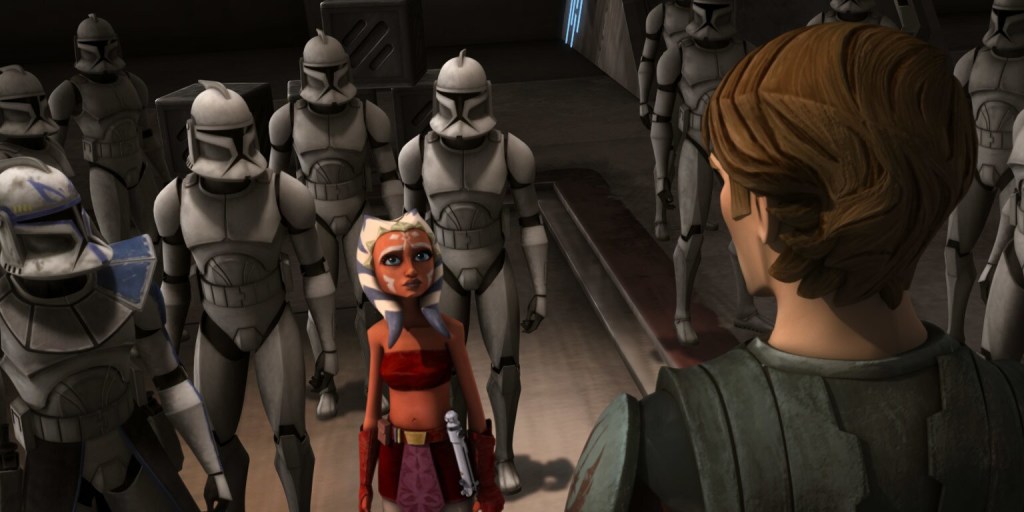
The Jedi Council further contributed to Ahsoka’s trauma by turning their back on her when she was accused of treason and betrayed by her fellow Padawan, Barriss Offee. Instead of defending her, the Jedi Council withdrew and let the democratic process take place, thus leaving Ahsoka vulnerable. Here, the institution failed her and further compounded her trauma in much the same way as many schools and institutions do in our world. Alex Shevrin Venet highlights these issues in her book, Equity-Centered Trauma Informed Education.
| We THINK it means… | It ACTUALLY means… |
|---|---|
| Social Emotional Curricula | Universal, Proactive, and Preventative measures (in school and out) |
| Anti Bullying Mandates | Anti-Racist, Anti-Oppressive |
| No Tolerance Policies | Systems of Support and fixing the systemic inequities that cause trauma |
| Kids and their trauma are something to be “fixed” | Trauma-informed practices in the classroom, district, and statewide. |
The Jedi Temple throughout was a source of institutional trauma for Ahsoka and many other Padawans, which led her to leave her apprenticeship with Anakin and make her way in the Force. According to Shevrin Venet, educational equity ensures that all students can have access to high-quality education, and more importantly, there are systems in place to help students to do so. She proposes that we as educators reframe our understanding of trauma and trauma-informed practices as a collective responsibility and work to prevent trauma from occurring, rather than waiting for trauma to occur and applying the band-aid afterward. Once Ahsoka leaves the institution, the Jedi Temple, she has a better chance of understanding how the Force truly works, and how she can contribute to a new path to Jedi enlightenment without adding institutional trauma.
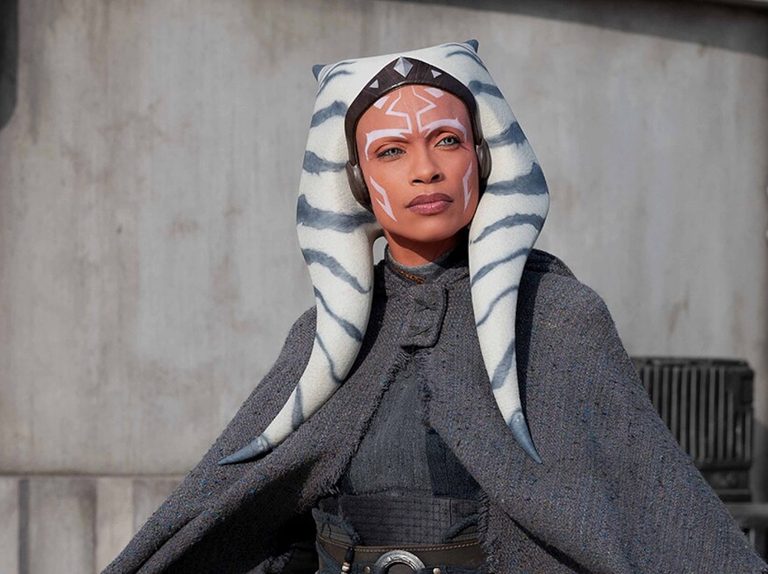
As a Master to Sabine, Ahsoka is very reserved. As Huyang so blithely points out, Sabine’s focus and abilities are trained entirely on her skills as a Mandalorian warrior. She is trained to trust these particular instincts, and she is not Force-sensitive as past Padawans were. Ahsoka has the tools to teach Sabine, but she lacks the confidence to do so. She also struggles to adapt her instruction to Sabine’s needs- Ahsoka knows how to fight, but she doesn’t know how to help Sabine trust herself and access the Force. In much of the same way, teachers today are given curriculum in Social Emotional Learning and Mindfulness techniques in the hopes that these will fix problematic student behaviors and teach them to cope with their trauma. But these practices are mere band-aids that don’t truly address the students’ needs. Ahsoka struggles to adapt her instruction because she hasn’t confronted her anxiety and trauma from the Clone Wars and the institutional trauma that taught her how to be a Jedi in the first place. It’s only until after her lesson with Anakin in the World Between Worlds that she learns how to let go of her trauma, and “choose[s] to live”. She lets go of the pressure of her apprenticeship with Anakin and the trauma that his turn to the dark side caused.

When Anakin became Darth Vader, he shook Ahsoka’s faith in herself. But in the World Between Worlds, Anakin helps Ahsoka see beyond the institution that failed her, and that although she is a part of that legacy, she is also her own Jedi and that she can grow beyond the legacies of the Jedi Temple and of Darth Vader. Anakin, and therefore Ahsoka, revitalize the true nature of the Master and Apprentice relationship, and the duality that Abdallah Rothman speaks to in Theology and the Star Wars Universe. Ahsoka, as the apprentice, achieves the liberation that she had been seeking since Anakin’s turn to the Dark Side, and thus can be a better Master to Sabine.
“For Sankara and for much of Hinduism, the educational method itself comprises a spirituality within which the relationship between guru and disciple can be perfected and the disciple can achieve liberation.” … “Liberation [is] the goal of self growth and self realization- characterized by the disciple freeing himself or herself from the psychospiritual limitations of identification with the ego self… thus stepping in to or becoming the true or “higher self” (Rothman, 82).
Throughout Star Wars: The Clone Wars and Ahsoka, we see the institutional harm that the Jedi Council and the Galactic Republic created, but Ahsoka’s abilities as a teacher show us that we can rework our systems to make our schools and our society equitable and truly trauma-responsive. Our public school systems need to let go of the old ways of trauma-based pedagogy and revolutionize the way we, as a society, approach trauma with equity and understanding. While we shouldn’t go to the extreme of executing Order 66, we should work to provide resources, funding, and training to teachers and mental health experts to ensure that our little apprentices are safe and happy in their schools.
All images of Ahsoka and the Clone Wars are the property of Lucasfilm and Walt Disney Studios.
Works Cited
- Ernest, Brian W., et al. “The State of Trauma-Informed Practice in Education: A Focused Review of Literature.” Educational Research, vol. 33, no. 1, 2022, pp. 7–13.
- Learning Sciences. “Ten Things to Know About Trauma and Learning | All4Ed.” All4Ed, 6 Sept. 2019, https://all4ed.org/blog/ten-things-to-know-about-trauma-and-learning/.
- “Mindfulness Won’t Save Us. Fixing the System Will.” ASCD, https://www.ascd.org/el/articles/mindfulness-wont-save-us-fixing-the-system-will. Accessed 13 Apr. 2024.
- Rothman, Abdallah. “From Padawan to Jedi: The Theological Premise for the Necessity of the Master Apprentice Relationship in the Path of Spiritual Ascension.” Theology and The Star Wars Universe, edited by Benjamin Espinoza, Lexington Books: The Rowman and Littlefield Publishing Group, 2022, pp. 61–80.
- “Shadow Warrior.” Ahsoka, directed by Dave Filoni, Streaming, 5, Disney Plus, 2023.
- Shevrin Venet, Alex. Equity-Centered Trauma-Informed Education. Norton Books in Education, W.W. Norton & Company, 2021.
- “Storm Over Ryloth.” Star Wars: The Clone Wars, directed by Dave Filoni, Streaming, 1.19, Disney Plus, 2008.
- What To Do When The Kids Aren’t Alright. https://learningforward.org/journal/teaching-in-turbulent-times/what-to-do-when-the-kids-arent-alright/. Accessed 13 Apr. 2024.
 Teaching With Magic